

Most people can give the textbook definition of accounts payable vs accounts receivable: accounts payable is what you owe suppliers, and accounts receivable is what customers owe you. True, but not especially useful once you’re trying to manage cash, improve cash flow visibility, close the month, and keep your controls defensible.
The real differences show up in how AP and AR behave operationally, who controls the timing, where the risks sit, and what good looks like when you zoom out beyond processing.
If you’re a CFO, finance manager, or leading an AP or AR team, getting clear on these differences helps you set the right controls and avoid treating both functions as just admin.
What is accounts payable
Accounts payable (AP) covers the organisation’s obligation to pay suppliers for goods and services already received. Operationally, AP is a workflow where invoice processing depends on accurate capture, matching, coding, approval, and payment timing. Invoices are validated, GL coded, approved, and then posted so they can be paid under agreed terms.
In practice, AP workload is shaped by supplier behaviour and internal discipline. If suppliers send invoices inconsistently, if purchase orders are created late, or if receipting is weak, AP becomes a constant exception management exercise.
AP also plays a quiet but important role in financial hygiene. If invoices are not captured and tracked early, accruals become guesswork, the close becomes slower, and it becomes harder to explain variances with confidence.
What is accounts receivable
Accounts receivable (AR) covers amounts owed to your organisation by customers for goods or services you’ve delivered. AR starts with issuing accurate invoices and ends with cash in the bank, reconciled correctly.
Day to day, AR work is shaped by your billing discipline and customer payment behaviour. If billing is late or inaccurate, you create disputes. If disputes are slow to resolve, your cash comes in late. If cash allocation is messy, reporting becomes unreliable and customer conversations get harder.
In many organisations, AR is where commercial relationships are felt most directly. The tone and speed of dispute resolution often matter as much as the invoice itself.
Balance Sheet treatment of AP and AR
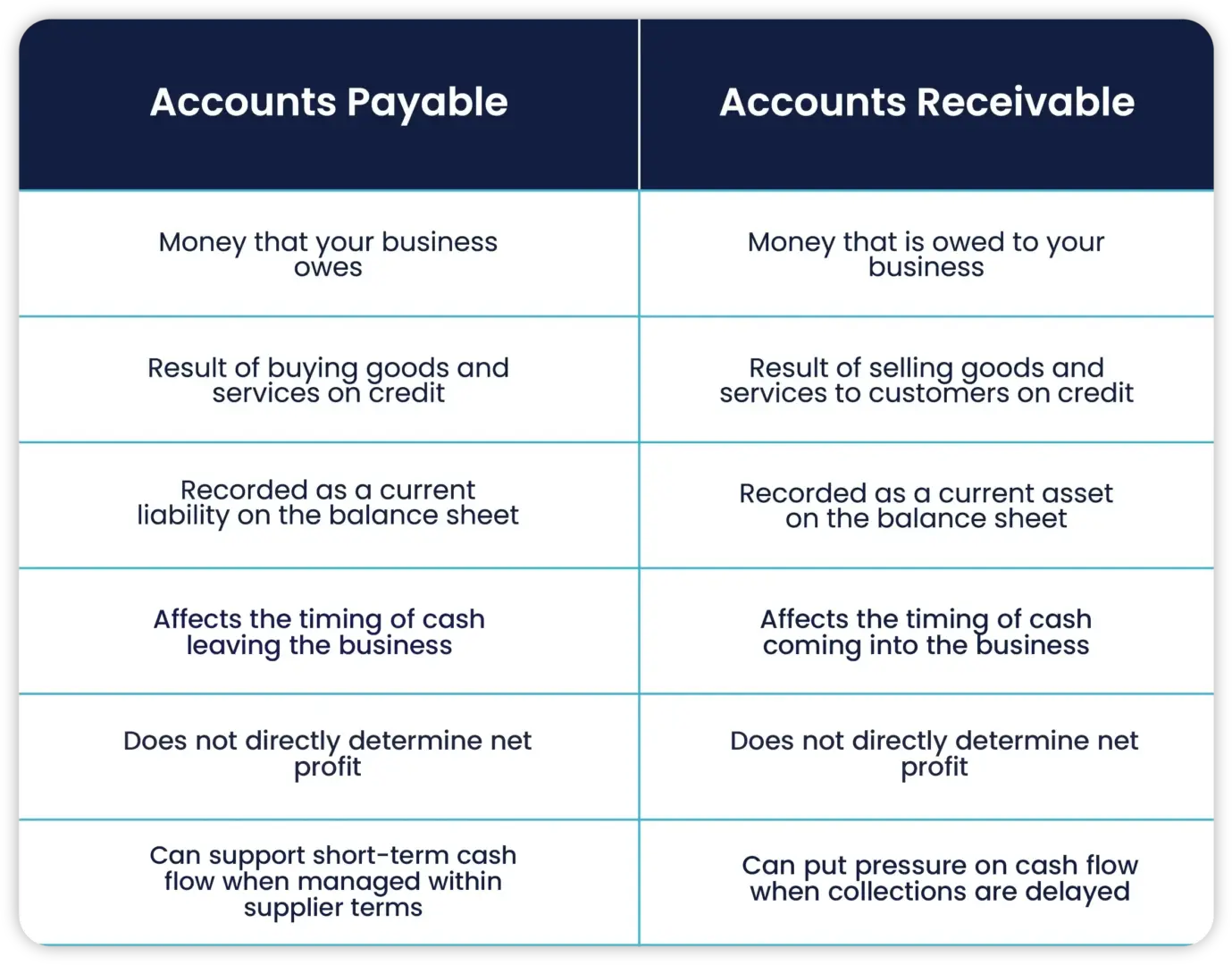
At an accounting level, the split is simple. AP is a liability because it represents amounts you need to pay. Account receive is an asset because it represents amounts you expect to receive.
Where it gets practical is working capital. AP and AR move in opposite directions, but they both affect the same outcomes: cash availability, forecasting confidence, and how much effort goes into managing short-term liquidity.
Timing Control in AP and AR
This is one of the most important operational differences.
With AP, timing is often controllable within the boundaries of payment terms, assuming invoices are approved and ready. If your process is clean, you can plan payments predictably and avoid last-minute scrambles.
With AR, timing is less controllable because it depends on customer behaviour and dispute resolution. You can influence it through billing accuracy, clear terms, and collections discipline, but you cannot approve a customer into paying.
This difference is why some organisations fall into bad habits. When AR is slow, they delay AP to protect cash. It can work in the short term, but it usually damages supplier relationships and creates operational friction that shows up later as supply issues, rush orders, and less favourable terms.
Risk exposure in Accounts Payable vs Accounts Receivable
The risk profiles are different, even when the functions sit in the same finance team.
Accounts payable risk is usually about money leaving when it shouldn’t or leaving without a defensible basis. That can look like duplicate payments, approvals that don’t align with the delegation of authority, weak segregation of duties, or supplier master data changes that are not controlled. It also shows up in audit, when supporting evidence is missing or scattered across inboxes.
Accounts receiveable risk is usually about money not arriving on time or not arriving at all. That includes credit risk and bad debts, revenue leakage from incorrect billing or pricing, slow dispute resolution, and extended DSO that quietly becomes normal.
Both matter. AP tends to have more immediate payment leakage and control exposure. AR tends to have more credit, revenue, and customer relationship exposure.
AP vs AR: How do the processes differ day to day
Even if both teams use the same ERP, the rhythm of the work feels different.
AP is largely inbound. Large volumes of supplier documents, varying formats, varying levels of quality, and constant dependencies on procurement, operations, and approvers.
AR is largely outbound. Billing discipline, due dates, dispute management, and collections cadence.
A useful way to think about it is this. AP’s job is to prevent money from leaving incorrectly. AR’s job is to make sure money comes in when it should and that it is applied cleanly.
Operational overlap between AP and AR
AP and AR are not separate lanes in practice. They collide in predictable places, and those collision points are often where reporting and cash flow get noisy.
Disputes and offsets
Customer disputes on the AR side often trace back to supplier issues on the AP side, like incorrect materials, delivery problems, or subcontractor performance. If you cannot link cause and ownership across the chain, disputes linger, and everyone blames finance.
Project accounting and margin
Supplier costs sit in AP and customer billings sit in AR, but both land on the same project. If AP GL coding is late or inaccurate, margin reporting gets distorted. That can trigger poor decisions, especially in environments where work in progress and milestone billing are material.
Pass through and recharge models
In many organisations, AP costs need to be recharged to customers through AR. If AP data is weak, recharges become slow, disputed, or under-recovered.
These are the scenarios where the quality of finance process directly affects operational decision-making, not just whether invoices are processed.
Characteristics of strong AP and AR operations
A well-run finance operation usually has AP and AR designed for control and predictability, not heroics.
For AP, good usually means clear invoice status visibility, structured approvals that match delegations, disciplined exception ownership, and supporting documents that are easy to retrieve.
For AR, good usually means accurate billing on time, fast dispute resolution, consistent collections cadence, and clean cash allocation so reporting is reliable.
What we often see in high-performing teams is shared definitions. Dispute reasons are categorised consistently. Root causes are tracked. Ownership boundaries are clear, so issues don’t bounce around until someone escalates.
Why AP automation often comes first
Many organisations prioritise AP automation before AR because AP is often more fragmented. Invoices arrive from multiple channels, approvals are decentralised, and exceptions are frequent. That combination makes visibility and control harder to sustain as volume grows.
Automation is not a shortcut for weak discipline, but it can reinforce a better operating model. Structured workflow, clear routing, and a reliable audit trail usually reduce chasing and make month end more predictable. The practical goal is consistency and visibility, not a marketing promise of touchless.
Key takeaways
- Accounts payable is about controlling outbound spend and ensuring payments are supported by the right evidence, approvals, and coding before money leaves the business.
- Accounts receivable is about issuing accurate invoices, resolving disputes quickly, and converting sales into cash that is correctly allocated and reported.
- AP is a liability and AR is an asset, but both directly shape working capital, cash forecasting, and month-end confidence.
- Timing is generally more controllable in AP within agreed supplier terms, while AR timing depends more on customer behaviour and dispute resolution.
- AP risk tends to show up as payment leakage and audit exposure, while AR risk tends to show up as disputes, extended DSO, and bad debts.
Frequently Asked Questions
What is the difference between accounts payable and accounts receivable?
Accounts payable is money the business owes to suppliers. Accounts receivable is money owed to the business by customers.
How accounts payable vs accounts receivable affects cash flow
Accounts payable affects when cash leaves the business. Accounts receivable affects when cash comes in.
Together, they have a direct impact on working capital, short-term liquidity, and the organisation’s ability to manage cash with confidence.
Why is accounts payable usually more controllable than accounts receivable?
In many organisations, AP timing is more controllable because payments are made according to agreed supplier terms and internal payment schedules.
AR is usually less predictable because it depends on customer payment behaviour, collections follow-up, and how quickly disputes are resolved.
Why do many organisations automate accounts payable before accounts receivable?
Many organisations begin with AP because the process is often more fragmented and administrative.
Supplier invoices arrive through multiple channels, approvals are spread across the business, and exceptions can be difficult to track. Automation helps bring more structure, visibility, and consistency to that workflow.
Do accounts payable and accounts receivable affect working capital?
Yes. Both AP and AR directly affect working capital.
AP influences the timing of outgoing cash. AR influences the timing of incoming cash. Together, they shape how much working capital is available to the business at any point in time.
Which is riskier: accounts payable or accounts receivable?
With AP, the risk is usually around control failure, duplicate payments, errors, fraud exposure, or poor payment timing. With AR, the risk is more often delayed collections, customer disputes, and bad debt.
In practice, the more important question is not which one is riskier in general, but where the business has weaker process control.
How do AP and AR work together?
AP and AR work together by giving finance teams visibility over both sides of cash flow.
AP shows when money is expected to leave the business through supplier payments, while AR shows when money is expected to come in through customer payments. When both functions are managed well, finance teams can improve forecasting, protect working capital, reduce risk, and make better payment decisions.