
Days Payable Outstanding, usually shortened to DPO, is one of the most commonly used working capital measures in finance. It estimates how long, on average, your organisation takes to pay suppliers.
On the surface, DPO looks like a simple lever. Extend DPO and you preserve cash longer. Reduce DPO and you pay faster. In practice, DPO is only useful when the underlying accounts payable data reflects what is actually happening. If invoices are received but not posted, or approvals are stuck outside defined timeframes, DPO can become a tidy number that does not match reality.
Used properly, DPO helps finance teams understand payment behaviour, cash posture, and how supplier terms are translating into day-to-day operations. It can also highlight AP workflow issues, particularly when invoices are being posted late, sitting unapproved, or accumulating in exception queues. That is why DPO should not be viewed as a target in isolation. A higher DPO is not automatically good, and a lower DPO is not automatically bad. Context matters.
This article explains how to calculate DPO, how to avoid common distortions, and how to interpret the result in a way that supports decisions rather than vanity metrics.
What is Days Payable Outstanding (DPO)
DPO describes the average time it takes to pay suppliers, based on the accounts payable balance and a measure of supplier spend over a period. You may still hear accounts payable days used informally, but in Australian finance reporting and working capital conversations, DPO is the clearer and more widely recognised term.
The limitation is the same either way. DPO depends on what is recorded in accounts payable. If invoices are received but not posted, the AP balance is understated and DPO can look misleadingly low. If invoices are posted in batches at period end, the closing balance can be inflated and DPO can swing without any real change in payment behaviour.
The standard DPO formula
A common and defensible way to calculate DPO is:

This formula is correct, but it only holds up when the inputs are consistent.
Average accounts payable should reflect the liability balance for the same time window used for supplier spend. Supplier spend must be measured across the same period as the day count. If you use annual spend, use 365 days. If you use a quarter, use the number of days in that quarter.
You can also present the same calculation in a way that makes the timing clearer:
DPO = Average Accounts Payable ÷ (Supplier Spend ÷ Number of days in the period)
Same maths, but it makes it obvious you are converting spend into a daily rate.
Choosing the right supplier spend measure for DPO
This is where many DPO calculations become inconsistent across organisations.
Typically, goods-based businesses use cost of goods sold because it broadly reflects supplier spend tied to inventory and production. In service-heavy organisations, cost of goods sold can be less representative, so purchases or operating expenses may better reflect what actually flows through accounts payable.
The most important decision is not which denominator is “right” in theory. It is whether the denominator reflects supplier activity in your environment and can be applied consistently over time. Consistency is what makes trends meaningful. If you change the denominator every time reporting is challenged, DPO stops being a useful signal.
In practice, it helps to document your chosen spend measure and keep it stable for at least 12 months, then review whether it still matches your operating model.
How do you calculate average accounts payable
The simplest approach is to average opening and closing accounts payable for the period:
Average AP = (Opening AP + Closing AP) ÷ 2
This works reasonably well when posting behaviour is steady.
Where posting is lumpy, it can distort DPO. What we often see is month end catch up, where invoices received earlier are posted late to meet reporting deadlines. That inflates the closing balance and can create an artificial DPO increase.
If volatility is a known issue, a more stable approach is to use additional data points. For example, averaging monthly closing balances across the year can reduce the influence of a single spike and provide a truer view of the liability pattern.
The goal is not mathematical perfection. It is to remove timing noise so that DPO movements reflect real changes rather than processing artefacts.
A worked example that shows the mechanics
Assume an opening accounts payable balance of $4 million and a closing balance of $5 million. Average accounts payable is $4.5 million.
Assume supplier spend for the year, measured as cost of goods sold, is $30 million.
Average AP ÷ Spend = $4.5m ÷ $30m = 0.15
DPO = 0.15 × 365 = 54.75 days
Rounded, that suggests the organisation pays suppliers in about 55 days on average, based on recorded AP balances and the spend proxy used.
The calculation is straightforward. The value comes from asking why the number is what it is, and why it changes over time.
Interpreting DPO in practice
DPO can reflect supplier terms. If standard terms shift from 30 days to 45 days, DPO should rise over time.
DPO can also reflect payment discipline. If the organisation pays on the due date rather than paying early to reduce supplier noise, DPO may rise even though risk has not increased.
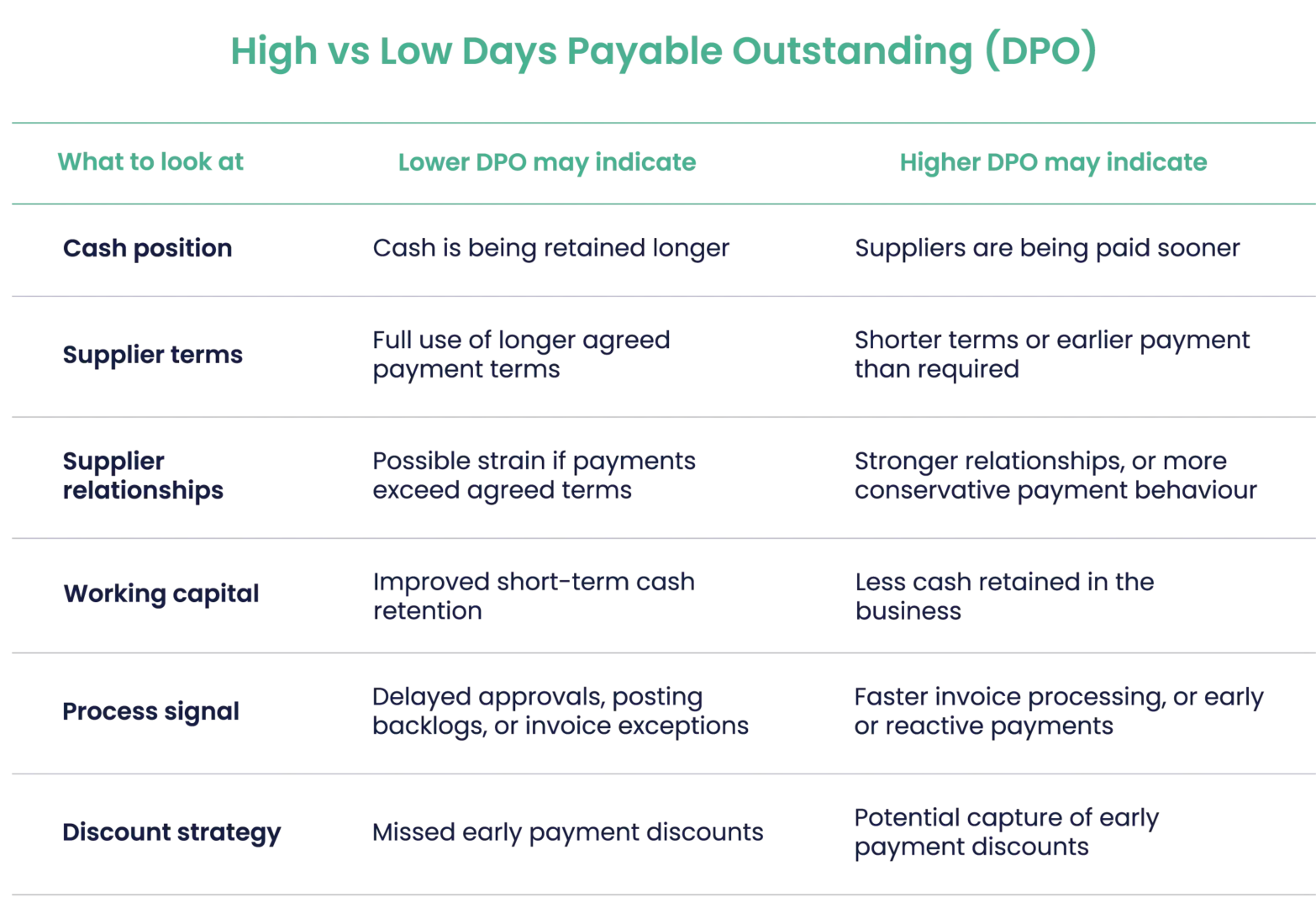
But DPO can also be driven by workflow issues. If approvals slow down, invoices sit unapproved or unposted, payables build up, and DPO rises even if the organisation has not deliberately changed payment behaviour. Conversely, DPO can fall if the organisation pays early to avoid supplier escalation. That can look like an improvement in a dashboard while controls weaken in the background.
This is why DPO should be interpreted alongside operational measures such as approval cycle time, backlog ageing, and exception rates.
Common DPO distortions in organisations
The most common distortion is invoices sitting outside the ERP. If invoices are received but not posted, the AP balance does not reflect true liabilities. DPO then looks artificially low because spend is recognised, but the payable is not.
The next distortion is inconsistent posting behaviour, particularly month-end batching. Posting timing can inflate the closing balance and create volatility that looks like a trend but is actually just processing timing.
Disputes and credit notes can also distort the view if they are handled inconsistently. If disputed invoices are left in AP without clear status, or credits are not applied in a timely way, the payable balance can move in ways that do not reflect genuine payment behaviour.
A reliable DPO view requires discipline in receipt, posting, and exception management. Without that, DPO becomes a number that looks precise but is not decision-ready.
How should finance teams use DPO without chasing the wrong outcome
DPO works best as a diagnostic and a conversation starter, not a standalone target.
If DPO rises, ask whether it rose because of deliberate term management, because payment timing was intentionally adjusted, or because invoices are stuck in the workflow. If DPO falls, ask whether the organisation is paying early by design, or paying early because the process is reactive and suppliers are escalating.
To make DPO useful, pair it with workflow indicators. If backlog ageing is rising and approval cycle time is increasing, a higher DPO may signal process friction rather than improved working capital. If backlog is stable and approvals are moving within defined timeframes, a higher DPO is more likely to reflect a deliberate payment strategy.
Frequently Asked Questions
What’s the simplest way to calculate DPO?
Use average accounts payable for the period, divide by supplier spend for the same period, then multiply by the number of days in that period.
Should we use COGS, purchases, or operating expenses in the denominator?
Use the measure that best reflects supplier spend in your environment and apply it consistently over time.
Why does our DPO swing even when nothing changed?
Often because invoices are posted late in batches or invoices are sitting outside the ERP, both of which distort the AP balance used in the calculation.
Is a higher DPO always better for working capital?
Not automatically. A rising DPO can reflect better term management, but it can also reflect approvals and exceptions slowing down.
What should we pair with DPO so it’s decision-ready?
Approval cycle time, backlog ageing, and exception rates, so you can tell whether DPO movement reflects strategy or process friction.
What is a good DPO ratio?
There is no universal good DPO. A healthy DPO depends on your supplier terms, industry norms, cash strategy, and how consistently invoices are recorded and approved. The most useful benchmark is usually your own trend over time, compared against agreed payment terms and process performance.
How often should you calculate DPO?
Most finance teams track DPO monthly as part of working capital reporting. Monthly tracking is frequent enough to spot changes in payment behaviour, posting delays, or approval bottlenecks without overreacting to daily fluctuations.
How is DPO different from DSO and the cash conversion cycle?
DPO measures how long you take to pay suppliers. DSO measures how long customers take to pay you. Both feed into the cash conversion cycle, which shows how long cash is tied up across payables, receivables, and inventory.
What does a low DPO mean?
A low DPO can mean the business is paying suppliers quickly, either because terms are short, payments are well controlled, or teams are paying early. It can also signal missed opportunities to preserve cash, especially if payments are being made earlier than required without a strategic reason.