
For many finance teams, the inbox still functions as an unofficial workflow engine. Invoices arrive there, supplier queries are handled there, and approvals are often chased there. This reliance on email creates a significant control weakness, making account takeover fraud an increasingly serious risk for AP teams and a common driver of payment scams in accounts payable.
Account takeover fraud is different to classic spoofing. The attacker is not pretending to be your colleague or your supplier from the outside. They are signing in as them. Once they have valid credentials, they can sit quietly inside real conversations, learn how payments get approved, then change the details just enough to redirect funds without triggering suspicion.
The hard part is this. When the email address is genuine, checking the sender does not protect you.
The typical stages of an AP payment scam
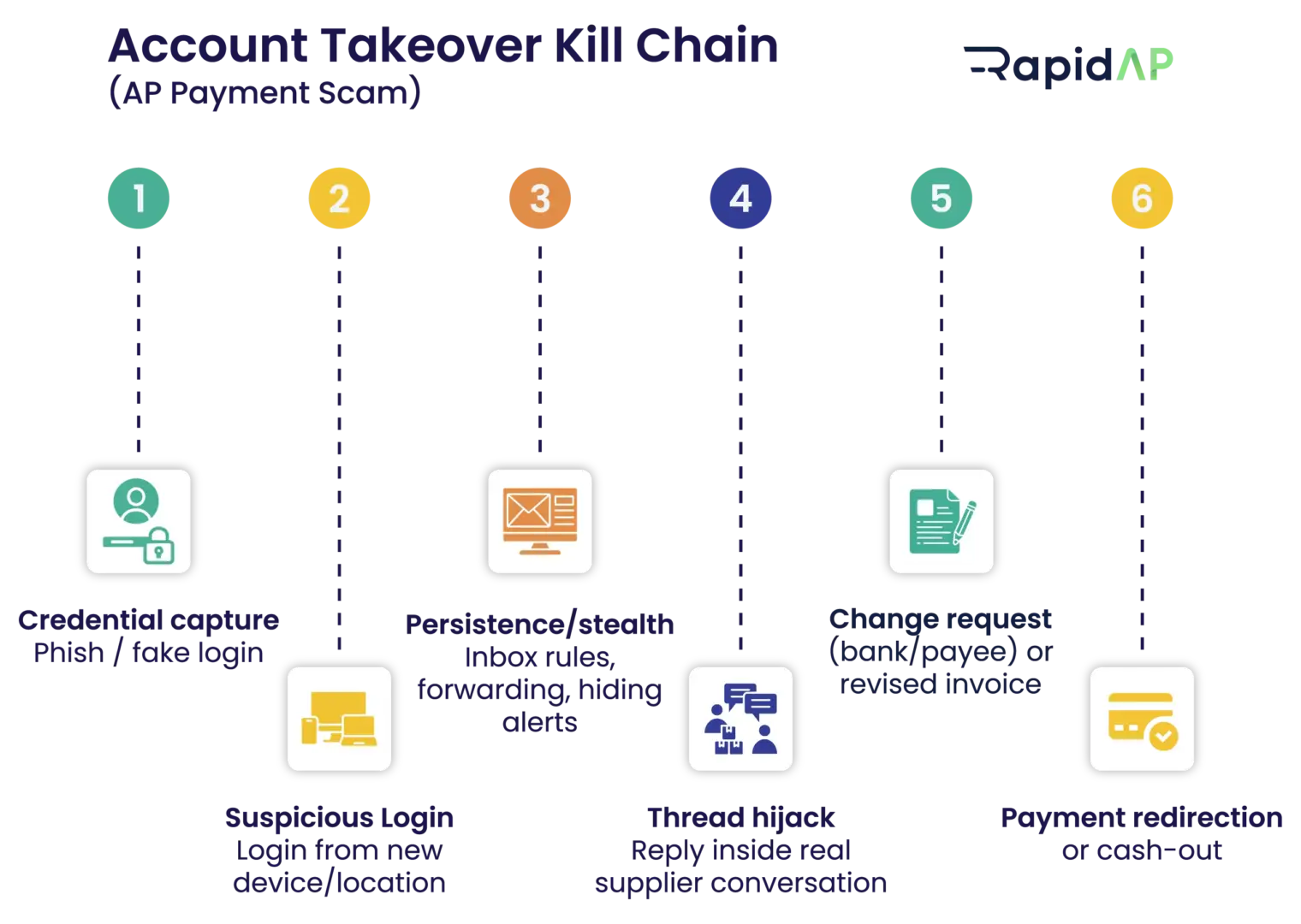
This infographic shows the typical path from credential capture to payment redirection in an AP account takeover scam.
How account takeover fraud unfolds in finance
Typically, it starts with credential theft. Someone clicks a convincing sign-in prompt, enters their username and password, and that is enough. From there, the attacker logs in from a new device or location and tries to stay invisible. This is one reason account takeover fraud is often discussed as part of the wider problem of business email compromise in finance, where trusted communications are used to manipulate payment activity.
What we often see next is inbox rule manipulation. New rules are created to forward messages containing words like invoice or payment, hide replies from suppliers, or divert security notifications away from the user’s view. That gives the attacker time to observe. They read existing threads, learn who handles what, and work out when urgency is most likely to succeed.
The payoff step usually looks mundane. A reply inside an existing supplier thread asking for bank details to be updated, a revised invoice attached for the same work, or a nudge to prioritise payment to avoid a late fee. Because it is happening inside a real thread from a real inbox, it looks legitimate.
Why email as a system of record exposes AP processes
In many organisations, email is doing jobs it was never designed for. It becomes the entry point for invoices, the approval channel, the archive, and the place where supplier master changes get negotiated. When that happens, one compromised mailbox becomes a single point of failure.
AP is particularly exposed because the work is repetitive and high volume. Teams are expected to move quickly, and the shape of a normal invoice or supplier request can be easy to mimic.
Signs that a supplier thread might be compromised
No single sign is definitive, but patterns matter. Long-standing suppliers suddenly pushing urgency, requests to change bank details without any supporting process, or subtle shifts in tone can all be clues. Another common sign is a request that keeps the conversation in email when it really should move into a controlled workflow.
At an organisational level, unexpected inbox rules and unexplained forwarding behaviour are important signals. They are not an AP problem alone, but AP teams are often the first to feel the consequences.
Why are strong sign-in controls necessary but not enough
Multi-factor sign-in, device monitoring, and restricting external forwarding rules are important. They reduce the chance of compromise and improve detection. But they do not remove the risk entirely.
A practical fraud posture assumes a mailbox will eventually be compromised. The real question is what the process allows after that.
A workflow-first approach to blocking hijacked accounts
The main design move is to decouple approvals and supplier master changes from email. Email can still be used for notifications, but it should not be the place where decisions are made or supplier details are changed.
Start with invoice ingestion. When invoices land in individual inboxes, an attacker can steer messages to the right person at the right time. When invoices flow through a central capture path into an AP workflow, you reduce that steering risk and ensure consistent validation steps happen before anyone approves anything.
Then address supplier changes. Bank details and payee changes should not be actioned off the back of an email thread, even a genuine one. This is where supplier bank detail fraud becomes especially dangerous, because a compromised mailbox can make a fraudulent change request appear legitimate. These requests should be raised through a structured process with defined approvals, supporting documentation, and independent verification using known contact details already on file. The aim is to make it impossible for a compromised email thread to directly change where money goes. A governed supplier verification workflow helps ensure these changes are reviewed consistently, validated independently, and recorded properly before any payment details are updated.
This is also where automated validation helps, because invoice payment scam prevention depends on surfacing anomalies before an item moves through to approval or payment. If an invoice arrives with bank details that do not match the supplier master, if an invoice number looks like a repeat, or if a bank change happens close to a high-value invoice, the workflow should slow down automatically and route the item for review rather than letting it slip through because it looks normal.
In higher-risk environments, some organisations add an independent verification layer so the check does not depend on the email thread at all. Where Eftsure is used, supplier bank details can be verified through Eftsure as part of the change process. If RapidAP is the workflow layer, the Eftsure verification step can sit inside the governed process so outcomes are recorded and any mismatch is treated as an exception rather than resolved inside a compromised conversation.
Segregation of duties matters here. In many organisations, the person processing invoices should not be able to change supplier bank details without independent oversight. Keeping supplier master maintenance with a small, trained group and requiring approvals outside the immediate reporting line reduces the chance that one compromised identity can complete the fraud loop.
Key takeaways for blocking account takeovers
Effective accounts payable fraud prevention starts with the assumption that email accounts may be compromised and that controls must stop those compromises from influencing supplier changes, approvals, or payments.
- Design AP processes on the assumption that a mailbox may eventually be compromised.
- Keep invoice capture out of individual inboxes and inside a controlled workflow.
- Do not approve supplier bank detail changes from email alone, even within genuine threads.
- Require structured requests, defined approvals, and independent verification for supplier changes.
- Use automated checks to surface bank mismatches, duplicates, and other suspicious patterns before payment.
Turning the inbox into a noticeboard, not a gatekeeper
In a mature model, the inbox tells you what is waiting, but it does not decide what happens next. Approvals happen inside the governed workflow where roles, thresholds, and audit history are enforced. Supplier changes are handled through structured requests. Email becomes a channel for communication, not the control surface for payments.
How workflow tools support account takeover prevention
Workflow tools help when they enforce rules consistently. In a rules-driven AP workflow, invoices are captured through controlled routes, duplicate checks are applied before posting, payee details are validated against supplier records, and exceptions are routed for review. In RapidP2P, those controls sit inside RapidAP workflows, and for bank detail changes, Eftsure can be integrated so verification is independent of the email thread and the outcome is recorded as part of the governed process.
Frequently Asked Questions
What is the difference between account takeover fraud and traditional email spoofing?
Email spoofing comes from outside the organisation and imitates a trusted sender. Account takeover fraud is more difficult to detect because the attacker gains access to a real account and operates inside genuine email threads.
Can multi-factor authentication fully prevent account takeover fraud in AP?
No. MFA and other sign-in controls are important, but they do not eliminate the risk completely. AP processes should be designed so that a compromised mailbox cannot directly trigger supplier changes, approvals, or payments.
What should AP teams do when a supplier email thread appears suspicious?
AP should pause the request and move it into a controlled workflow. Any bank detail change, revised invoice, or urgent payment request should be verified through structured approvals and independent contact details already on file.
Why should supplier bank detail changes never be approved through email alone?
Because even a genuine-looking email thread may have been compromised. Routing bank detail changes through a governed process with verification and approval controls makes it much harder for fraudsters to redirect payments.