
In early 2024, a finance employee at a multinational authorised a transfer worth more than US$25 million after joining what looked like a routine video call with senior colleagues. The faces looked familiar. The voices sounded right. The direction felt urgent and plausible. Only later did the organisation learn the people on screen were synthetic replicas designed to pressure one person into bypassing the process. Cases like this show why accounts payable fraud prevention is now a critical priority for modern finance teams, especially across broader finance and P2P workflows.
That kind of scenario used to feel like science fiction. Now it is a realistic risk for finance, accounts payable, and procure-to-pay teams.
Fraudsters have moved well beyond clumsy phishing emails and obviously fake invoices. They can impersonate leaders convincingly across voice and video, compromise real inboxes and respond inside genuine threads, and generate invoices and change requests that pass a basic eye test in seconds. At the same time, finance functions are under pressure to do more with less. Approvals happen quickly, teams are distributed, and invoices arrive through multiple channels. That operational complexity is exactly what criminals rely on.
The uncomfortable truth is that modern fraud in finance is increasingly hiding inside existing approval paths, not just in the spam folder. The most reliable defence is not hoping people spot what is wrong. It is designing workflows that apply the right friction at the right time, making accounts payable fraud prevention part of the process itself, especially when bank details, supplier master data, or unusual approvals are involved.
Key takeaways
Finance fraud prevention starts with making high-risk steps non-negotiable, especially when pressure, urgency, or authority enter the process.
- Modern fraud succeeds when urgency pushes work into side channels and controls become optional.
- In practice, finance fraud prevention depends on workflow design that makes high-risk steps non-negotiable.
- The biggest fraud risks for AP are executive impersonation, account takeovers, and synthetic or forged documents.
- Supplier bank detail changes are one of the highest-risk choke points and should always trigger structured verification.
- Effective fraud prevention combines workflow controls, consistent validation checks, and shared ownership across finance, procurement, IT, and internal audit.
Fraud patterns most likely to reach your AP team
Most fraud attempts that succeed in finance have one thing in common. They do not try to outsmart your controls head-on. They try to route around them by exploiting urgency, authority, and informal channels.
Executive Impersonation
Executive impersonation attacks mimic senior leaders to push staff into making an exception. The request usually sounds time-critical or confidential. It does not need to be perfect. It only needs to be believable enough to remove one or two checks. learn more
Account Takeovers
Account takeovers flip the model. Instead of impersonating someone from the outside, the attacker signs in as them. They watch real threads, learn how approvals happen, then reply inside genuine conversations to change bank details or request a revised invoice. From AP’s perspective, the email address is real, the thread history is intact, and the tone is close enough.
Synthetic Invoices and Forged Documents
Synthetic invoices and forged documents are often less dramatic, which is why it often travels further. Fake invoices may mimic a real supplier’s layout. Onboarding forms may look like your templates. Remittance change requests may appear routine. When documents can be generated quickly and convincingly, visual checks stop being a dependable control.
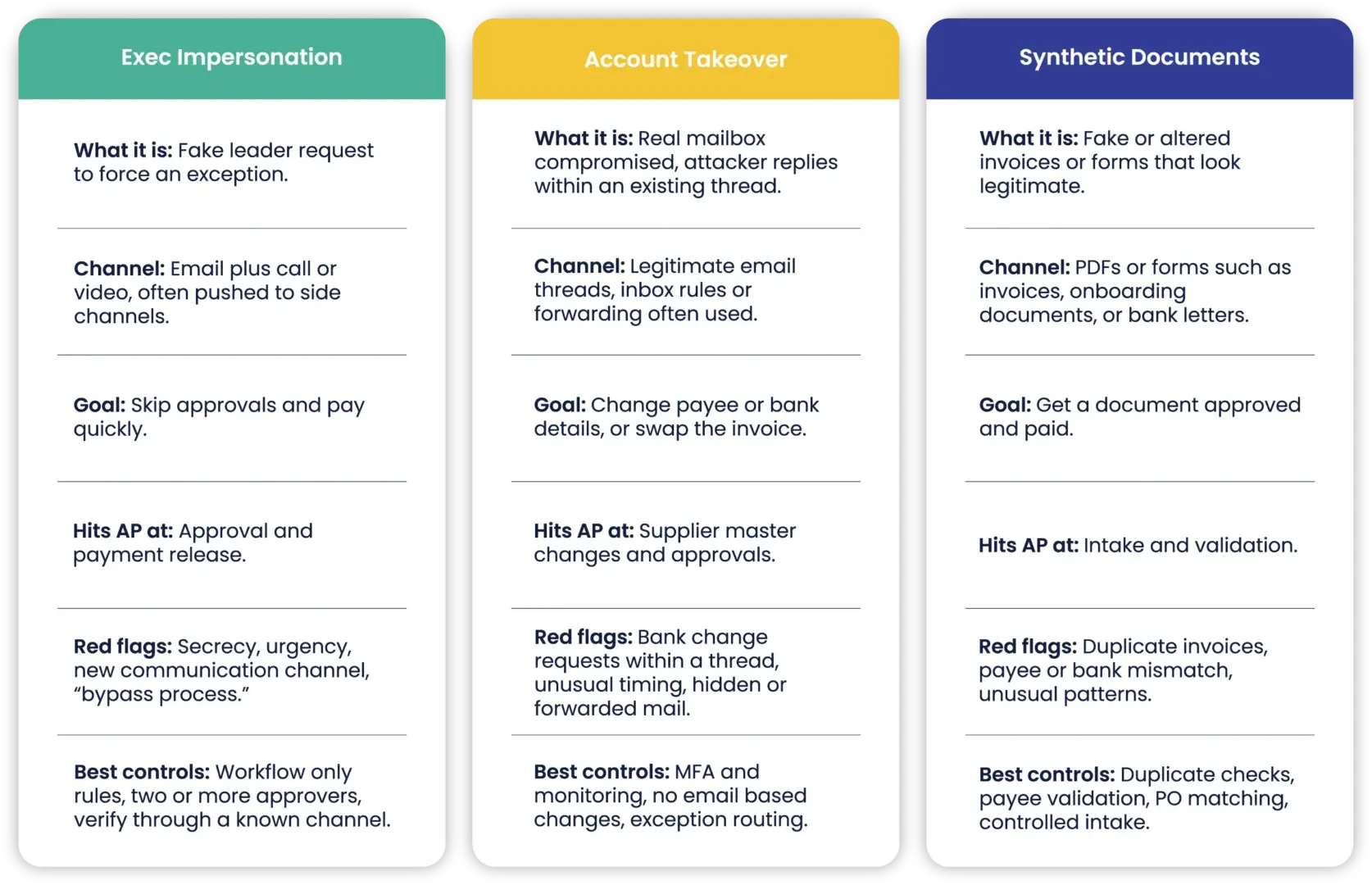
A side-by-side view of modern fraud risks in AP
This comparison shows how executive impersonation, account takeover, and synthetic documents differ in channel, intent, red flags, and controls.
Why do traditional controls struggle against modern fraud
Traditional controls often assume you can trust identity cues and that a careful person will spot what looks wrong. Modern fraud undermines both. A believable voice or face creates false confidence. A compromised inbox makes the sender look legitimate. Synthetic documents reduce the value of this, which looks like our supplier.
That is why effective fraud defence tends to look less like a single clever control and more like layered workflow design. You assume deception is possible, you increase friction when risk increases, and you make sure controls apply consistently, not only when someone remembers.
Practical steps to strengthen accounts payable fraud prevention across AP and P2P
There is no single control that blocks every modern attack. What works is a set of practical steps that strengthen verification, reduce side channels, and make high-risk changes visible and auditable, which is the foundation of effective fraud prevention in accounts payable.
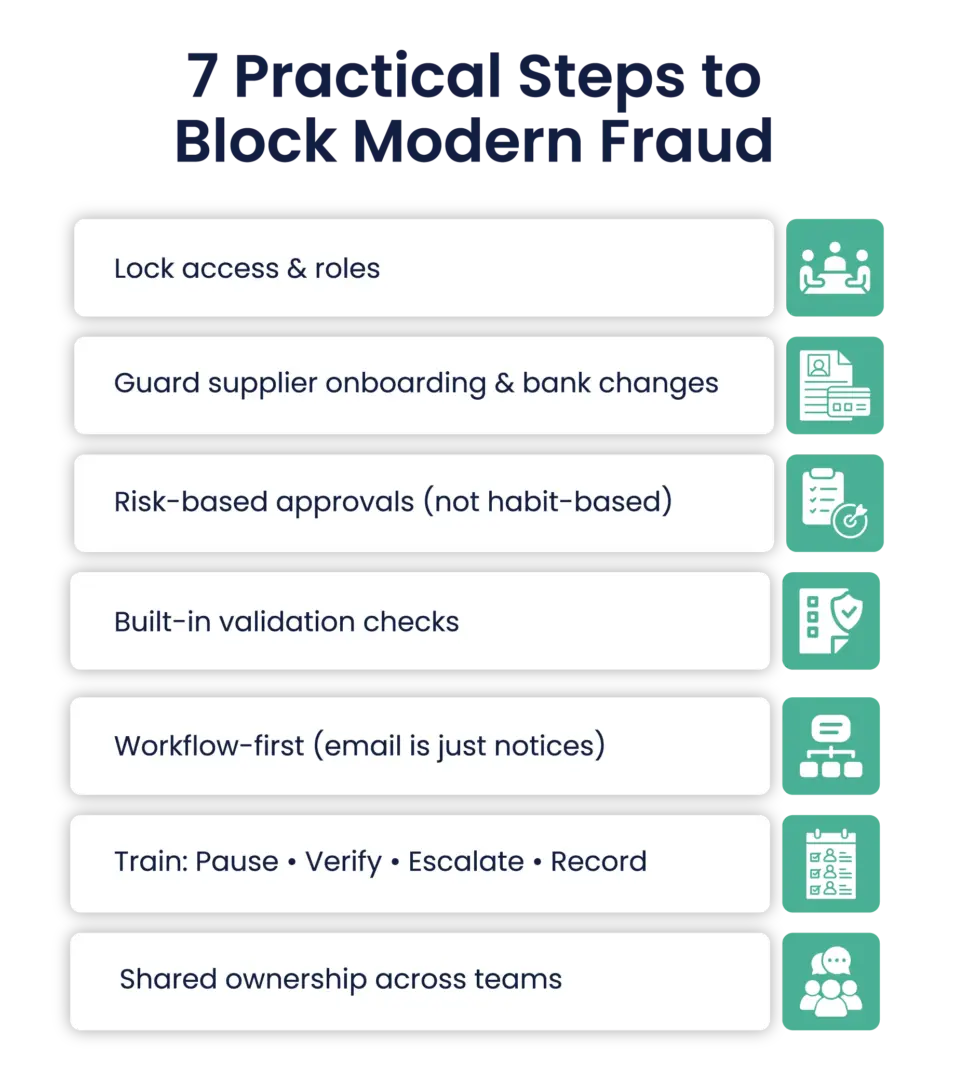
Step 1: Close the obvious gaps in access and authority
Fraud prevention still starts with basics. Strong sign-in controls, clear role permissions, and separation of duties reduce reliance on trust me steps and make unusual activity easier to spot.
In many organisations, the highest risk permissions cluster around supplier bank detail changes, supplier master maintenance, and payment preparation activities. The practical move is to reduce who can do what, and ensure no one person can complete the full chain from changing where a supplier is paid to releasing a high-value outcome without oversight.
It is also worth treating inbox rules as a finance risk signal, not only an IT concern. If forwarding and deletion rules can hide supplier and payment messages, a takeover can operate quietly for longer than most teams expect.
Step 2: Put supplier onboarding and bank detail changes behind guardrails
Modern fraud often succeeds by redirecting payment to an existing supplier rather than creating a new one. The control here is not “be careful”. It is process design.
Onboarding and changes should be centralised into a consistent workflow with structured requests, approvals, and history. Bank detail changes should be treated as high risk every time, regardless of how legitimate the request appears.
The verification rule that holds up best in practice is using a trusted channel already on file. Do not verify a bank change using the phone number or signature block included in the request. Verify using known details from your supplier records or corporate directory, and keep evidence of what was verified, by whom, and when.
In an Australian context, onboarding controls also benefit from validating supplier identity early. A simple but effective check is verifying the ABN and confirming the legal name aligns with the Australian Business Register. That does not turn AP into compliance auditors. It prevents obvious mismatches from entering the supplier master file and reduces how often you are relying on judgment later.
Step 3: Design approvals around risk, not habit
Approval paths in AP often grow organically. Over time, that can create the worst combination: low-value invoices with heavy manual effort, while high-value or unusual exceptions get waved through informally because everyone is busy.
A more resilient model ties approval friction to risk. Low-risk items should flow with minimal disruption, but the workflow should automatically slow down when warning signs appear, such as new suppliers, recent bank detail changes, unusual timing, unusual destination accounts, or invoices that do not behave like normal spend for that supplier.
For high-value items, the goal is more than one person and more than one perspective. Separating approvers across roles or reporting lines makes executive pressure and single-person error far less monetisable.
Step 4: Build validation checks into everyday workflows
Approvers should not be expected to catch subtle manipulation by eye. Effective invoice fraud prevention depends on building validation checks into everyday workflows so the process does the heavy lifting.
At a minimum, invoice processing should detect duplicates before posting, validate payee details against the supplier master, and route exceptions that require human review. Duplicate checks remain one of the most practical controls because reused invoice numbers and near duplicates are still a common tactic, particularly when attackers are aiming for small values that blend into volume. Payee validation matters because many fraud attempts fail when the bank details do not align with what the supplier master file expects.
Where purchase orders are in play, matching adds a strong behavioural control because it ties invoices back to an approved commitment and a known supplier record. The objective is not to treat every exception as fraud. It is to ensure exceptions cannot slide through quietly because someone is under pressure.
Step 5: Move from email-first to workflow-first
Email is useful for communication and notifications. It is not a safe system of record for approvals, supplier bank detail changes, or high-risk verification, which is why payment fraud prevention for finance teams increasingly depends on shifting those actions into governed workflows.
A workflow-first model brings control back into a governed path. Invoices enter through defined ingestion routes. Approvals happen inside the workflow tool where roles, thresholds, and audit history are enforced. Supplier onboarding and change requests follow structured processes rather than email threads.
Step 6: Train teams to pause, verify, escalate, and record
Controls only work when people feel supported to use them. Training works best when it is short, frequent, and based on examples from your workflows. The goal is to build a shared muscle memory: pause, verify, escalate, record.
Leadership messaging is a control in its own right. Teams need to hear that they will not be criticised for slowing down to verify a high-risk request, even if it appears to come from a senior leader. Without that, people choose speed over process, especially at month end.
Step 7: Share fraud ownership across teams
Modern fraud touches finance, procurement, IT, and internal audit. No single team sees the full picture. A lightweight working group creates shared ownership and keeps controls current. It helps you share attempted scams and near misses, prioritise workflow changes based on real incidents, align automation priorities with risk appetite, and track whether controls are reducing incidents or simply moving them elsewhere.
What does accounts payable fraud prevention through workflow mean in plain terms
Deepfakes, account takeovers, and synthetic paperwork are likely to remain part of the threat landscape. The goal is not to make finance paranoid. It is to make it resilient.
Resilient workflows assume identity cues and documents can be manipulated. They require more than one person and more than one channel to move high-risk funds. They apply controls consistently through governed workflows rather than memory. They make it easy to pause, verify, and escalate without friction.
Where does automation fit in vendor bank detail verification and fraud control
Automation helps when it enforces rules consistently. Deterministic workflows apply thresholds, route approvals, flag exceptions, and preserve audit history so control does not depend on someone remembering what to do under pressure.
In practice, this is where a governed AP and P2P platform can make controls repeatable and support stronger P2P fraud prevention through rules-driven workflows, validation, and exception handling. RapidP2P supports rules-driven workflows across invoice processing, supplier onboarding, and supplier change management, so invoices can be captured through controlled routes, checked for duplicates, validated against supplier records, and routed through exception handling when behaviour does not match expectations.
During onboarding, ABN and legal name checks can be enforced as part of the process, rather than performed ad hoc. For bank detail changes, RapidAP can integrate with Eftsure so supplier bank details are verified through an independent step within the workflow, with the outcome recorded and any mismatch escalated as an exception rather than resolved in email.
Frequently Asked Questions
What is the single highest risk change AP should treat as suspicious every time?
Anything that changes where money goes, especially supplier bank detail changes, payee updates, or requests to use a new account just for this payment. Even when the request looks legitimate, treat it as high risk by default and require structured verification and approvals.
How should AP verify bank detail changes safely?
Verify using a trusted channel that is already on file, not the contact details included in the request. Capture the request in a controlled workflow, confirm details using the supplier master file or corporate directory, and apply vendor bank detail verification through an independent step so outcomes are recorded and exceptions are escalated consistently.
What validation checks reduce the risk of fake invoices getting through?
Start with behavioural controls that run consistently: duplicate detection before posting, payee validation against supplier master data, and matching to purchase orders where applicable. The aim is to surface anomalies early and route them to review, rather than relying on approvers to spot issues visually.
How do we reduce fraud risk without slowing AP to a crawl?
Use risk-based friction. Keep low-risk invoices moving, but automatically slow down when risk signals appear, such as new suppliers, recent bank detail changes, unusual timing or amounts, mismatched payee details, or duplicate patterns.
What should we do if we suspect an inbox or supplier thread is compromised?
Pause the transaction immediately, move verification out of email, and confirm details through known contacts and controlled tools. Escalate to IT or security to check sign-ins and inbox rules, and document actions and decisions in the workflow so the audit trail is complete.