
Accounts payable automation is often discussed in terms of features such as faster capture, fewer emails, and better dashboards, but AP automation KPIs are what CFOs use to judge whether the investment has delivered real value.
CFOs care about outcomes. They want to see lower operating costs, faster and more predictable processing, stronger controls, and better visibility into liabilities and risk. The way they assess this is through a small set of KPIs that reflect the health of the entire invoice lifecycle, not just one step in the process.
This explains how CFOs actually measure AP automation performance, which KPIs matter most in practice, and how those metrics are interpreted in an Australian finance context.
Which AP automation KPIs matter most to CFOs?
Before looking at KPIs, it is important to understand the problems CFOs are trying to solve.
From a finance leadership perspective, AP automation is expected to deliver improvements in four areas:
Cost Efficiency
Reducing the total effort required to process invoices, including AP labour, approver time, and exception handling.
Predictability
Making invoice processing times consistent enough to support reliable accruals and month end close.
Control and Risk
Strengthening governance around supplier data, duplicates, approvals, and audit evidence.
Visibility
Providing timely insight into invoice status, bottlenecks, and emerging issues so finance can act earlier.
KPIs matter because they translate these expectations into measurable evidence.
Why CFOs look past activity metrics
AP teams often track activity: invoices processed, emails cleared, exceptions resolved. These measures can be useful internally, but CFOs tend to treat them with caution.
Activity metrics can improve while outcomes deteriorate. For example, invoices processed may increase while cycle times stretch and disputes rise. From a CFO’s point of view, that is not success.
CFOs prefer outcome based KPIs because they reveal whether the process is genuinely improving or simply working harder.

Cost per invoice: the anchor metric
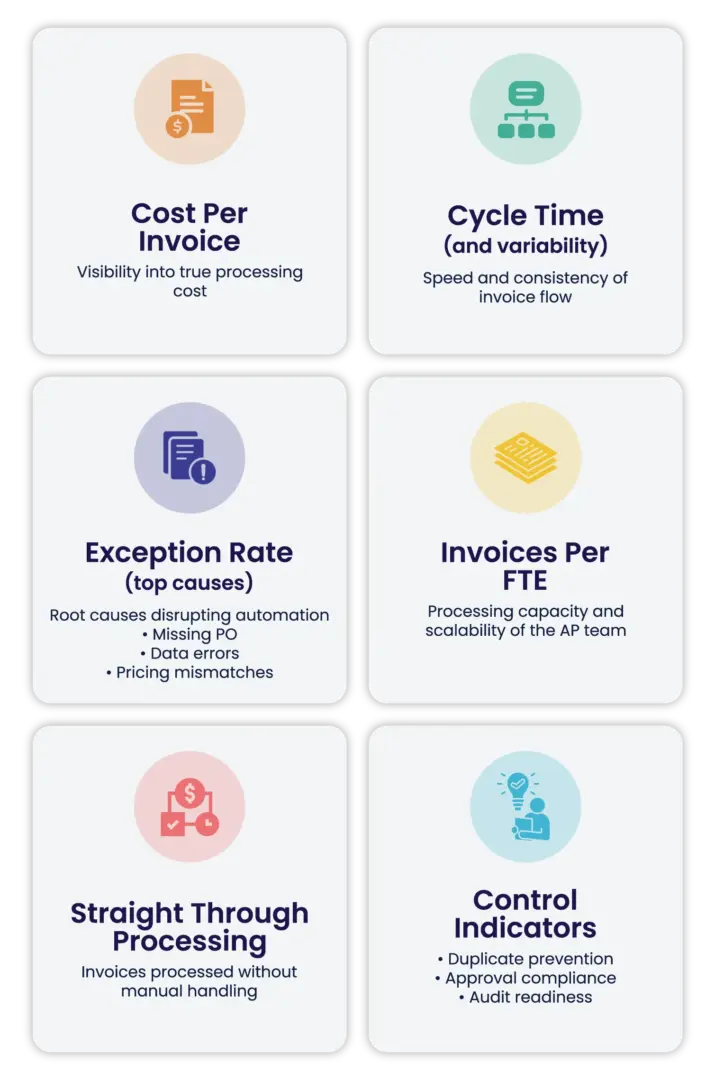
Cost per invoice is often the starting point for CFO assessment because it connects AP performance directly to operating cost.
A credible cost per invoice includes more than AP salaries. It typically accounts for:
- AP handling time across receipt, validation, matching, and follow-up
- Approver time spent reviewing, rejecting, and re-approving invoices
- Exception handling effort, including investigation and coordination
- Audit and compliance effort, such as document retrieval
- Systems and overhead costs supporting invoice processing
CFOs often want this KPI segmented, particularly between PO and non-PO invoices, because behaviour and effort differ significantly.
A falling cost per invoice over time is a strong signal that automation is removing work, not just shifting it.
Invoice cycle time and predictability
Cycle time measures the elapsed time from invoice receipt to ERP posting. CFOs care because cycle time affects:
- Late payment risk and supplier relationships
- The ability to capture early payment discounts where applicable
- Accrual accuracy and confidence at month end
CFOs often look beyond averages. Averages can hide long delays. What matters is distribution: how many invoices move quickly and how many get stuck.
Breaking cycle time into stages, such as receipt to validation, validation to approval, and approval to posting, helps identify where delays originate.
Straight through processing as a scaling indicator
Straight through processing measures the percentage of invoices that move through the process without manual intervention.
CFOs value this KPI because it indicates scalability. Higher straight through processing means the organisation can absorb invoice growth without proportional headcount increases.
However, CFOs rarely expect this number to reach one hundred percent. Some invoices should require review. The goal is to maximise touchless processing for low-risk invoices while keeping controls strong.
Exception rate and exception causes
Exceptions are where cost and delay accumulate, so CFOs pay close attention to them.
Useful exception reporting includes:
- The overall exception rate
- The top exception categories
- Trends over time
- Resolution time by exception type
This data often reveals that many exceptions originate outside AP, such as missing purchase orders or late receipting. For CFOs, that insight is valuable because it informs where governance and accountability need to improve.
Productivity and quality indicators
Invoices processed per FTE is often used as a productivity measure, but CFOs interpret it alongside quality indicators.
Rising productivity is only meaningful if:
- Cycle time is stable or improving
- Exception rates are falling
- Supplier disputes are not increasing
Quality indicators such as first time right posting and dispute rates help CFOs assess whether automation is improving outcomes or pushing problems downstream.
Control and governance indicators
Automation should strengthen governance, not weaken it. CFOs look for evidence such as:
- Duplicate invoices prevented
- Supplier status checks applied
- Approval compliance against delegation
- Completeness of audit trails and supporting documentation
These indicators support audit readiness and reduce exposure to recovery work and reputational risk.
Turning KPIs into a finance narrative
CFOs do not present KPIs in isolation. They convert them into a narrative:
- Lower cost per invoice multiplied by volume shows operating savings
- Higher invoices per FTE shows capacity released
- Reduced exceptions and duplicates demonstrate risk reduction
The credibility of this narrative depends on consistent definitions and sustained trends.
Where RapidAP fits, briefly
RapidAP supports invoice lifecycle visibility, audit trails, data exports, and the rules-driven workflow controls that underpin these KPIs. Invoice capture focuses on invoices and credit notes using ABBYY OCR and Peppol ingestion where configured.
Key takeaways
- CFOs judge AP automation by outcomes, not activity. Metrics like “invoices processed” matter less than whether cost, speed, and control improve.
- Cost per invoice is the anchor KPI for ROI. It must include AP effort, approver time, exception handling, compliance/audit work, and overhead, not just AP salaries.
- Cycle time predictability matters as much as speed. CFOs look at variability and bottlenecks across stages because it impacts accrual accuracy, month-end close, and supplier risk.
- Straight-through processing shows scalability. Higher touchless processing means invoice volume can grow without proportional headcount, while still keeping controls for higher-risk invoices.
- Exceptions and controls reveal where risk and waste live. Tracking exception causes, duplicates prevented, approval compliance, and audit trail completeness highlights governance gaps (often outside AP) and strengthens assurance.