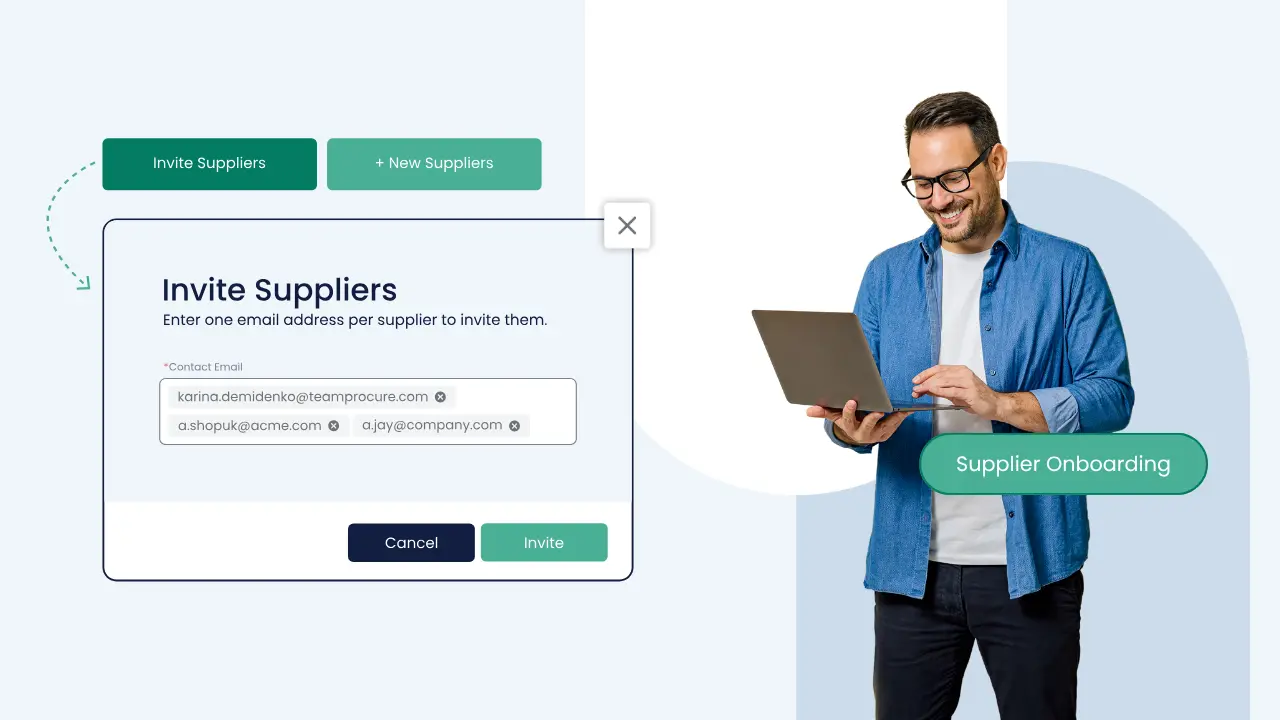
Supplier onboarding often breaks down in a specific place. Not in the can we pay them? And not in the can they trade smoothly? It breaks in the compliance layer, where organisations must automate supplier onboarding to make evidence collection, approval and ongoing compliance more consistent and auditable.
When that layer is handled through email chains, shared drives and spreadsheets, the outcome is predictable. Onboarding gets labelled slow, teams bypass the process, and compliance becomes reactive. The goal of automation here is not to add gates. It is to make compliance repeatable, auditable and low friction, so suppliers can be approved quickly when they meet requirements and blocked quickly when they don’t. In many procurement and finance environments, supplier onboarding is also referred to as vendor onboarding.
Key takeaways
- Compliance onboarding becomes slow when it’s manual and inconsistent (email/spreadsheets), not because requirements exist.
- Automation should make compliance repeatable, auditable, and low-friction, approve fast when requirements are met, block fast when they aren’t.
- Tier requirements by risk/exposure so low-risk suppliers have a lightweight path and high-risk suppliers get deeper scrutiny.
- Automate first the coordination work: self-service submissions → completeness checks → risk-based routing → reminders/escalations → audit trail capture.
- A reliable audit trail must show what was reviewed, which version, who approved, when, and under what risk tier.
What does supplier onboarding compliance automation mean
Supplier onboarding compliance automation uses structured workflows and rules to manage supplier evidence and risk checks.
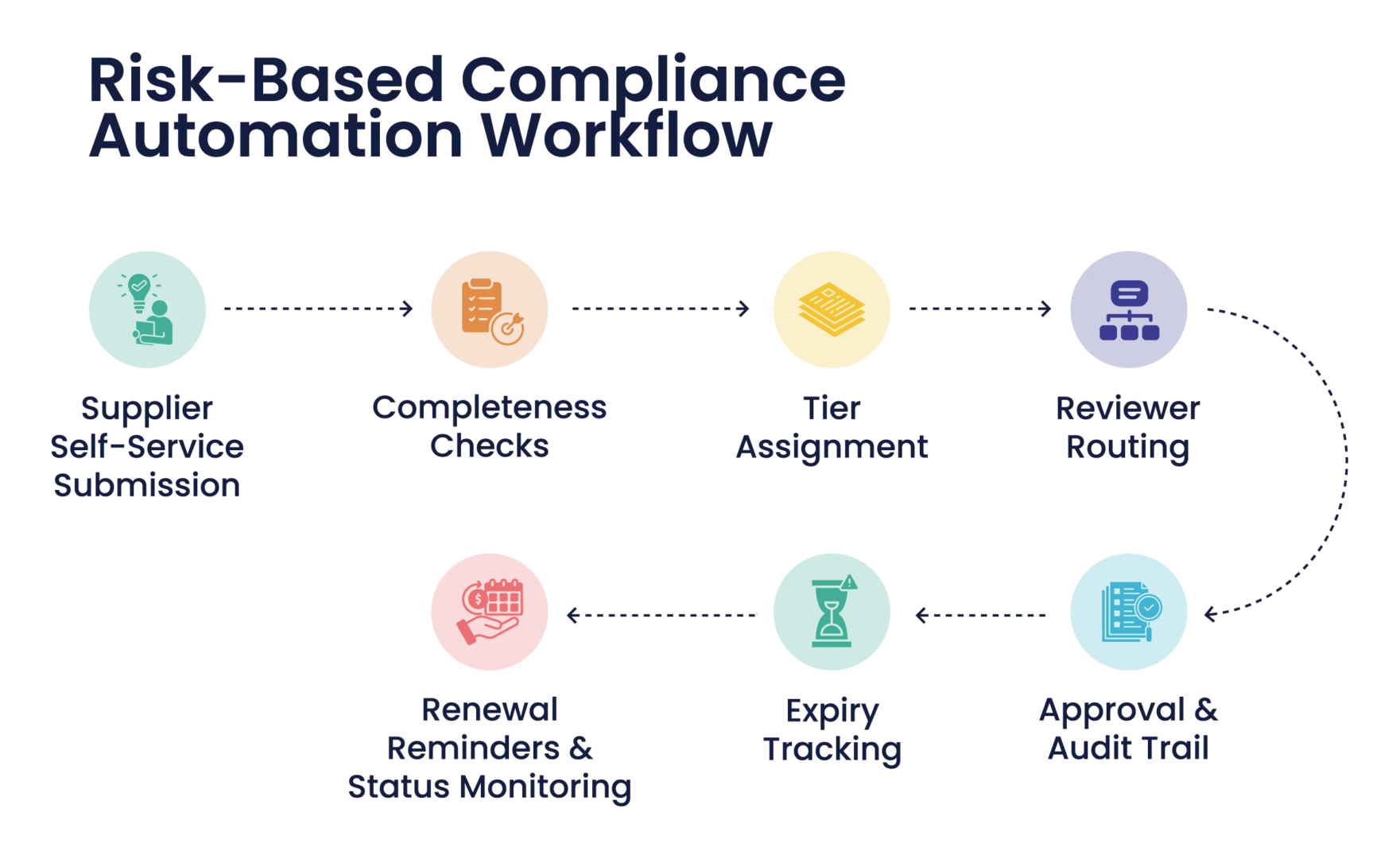
Typically, it includes guided supplier submissions, completeness checks, routing approvals to the right reviewers based on risk, capturing an audit trail of who approved what and when, and tracking expiry dates so revalidation happens on time.
It is a different problem space to payment setup controls and procurement trading enablement. It sits alongside those workflows, but success measures are governance and auditability at scale.
Why compliance onboarding becomes a bottleneck
If compliance onboarding feels slow, it is rarely because requirements exist. It is because they are executed manually and inconsistently.
What we often see is that requirements are not tiered, so low-risk suppliers face the same demands as high-risk suppliers. Evidence collection is unstructured, so suppliers send documents in random formats to random people, and nobody trusts whether the “latest” file is actually the latest. Reviews are not routed clearly, so documents sit in inboxes because ownership is unclear. Finally, compliance is treated as a one-time event, even though evidence expires and risk returns quietly months after onboarding.
Automation removes the repetitive coordination work: submissions, completeness checks, routing, reminders and audit trail capture.
Tiering requirements without weakening governance
Start with a simple tier model, using risk drivers your organisation already understands. Exposure is the guide, not preference. Typical drivers include service type, data access sensitivity, whether on-site access is required, and regulatory obligations.
Define requirement bundles per tier. The most important principle is that low-risk suppliers should have a lightweight path. If every supplier must provide everything, you create delay and teach the business to see compliance as red tape.
How to automate supplier onboarding to reduce cycle time
If you try to automate all reviews first, most programs stall. The early wins are in making submissions structured and making the workflow do the chasing.
A practical sequence is to introduce supplier self-service submission with clear instructions, apply basic completeness checks that flag missing items early, route evidence automatically to the correct reviewers based on the tier and requirement type, and use reminders plus escalation rules when reviews exceed an agreed SLA.
Even if humans still make the final approval decision, removing the coordination work is where the cycle time usually drops.
Building a reliable audit trail
In audits and investigations, the question is not only whether we collect the document? It is what was reviewed, who approved it, what version was approved, when it happened, and what risk tier applied at the time.
A compliance workflow should produce that trail by default. Where approvals happen in email, you end up with weak traceability even if the right people were involved.
Continuous compliance after onboarding
The biggest governance benefit comes after onboarding. Evidence expires. People change roles. Suppliers change insurance providers. What was compliant at onboarding can become non-compliant later without anyone noticing.
At minimum, automate expiry reminders to suppliers and internal owners, escalation when evidence is not refreshed by a deadline, and status signals such as compliant, expiring soon, and non-compliant. This prevents compliance drift and reduces last-minute firefighting when a supplier is already engaged.
Measures that prove Automation is working
Cycle time matters, but first pass submission rate often tells you more. It shows whether the requirements are clear and whether the supplier submission is working. Review SLA adherence indicates whether routing is reducing delays. Renewal compliance rate proves you have prevented drift.
If cycle time improves but renewal compliance worsens, you have sped up onboarding at the cost of long-term exposure.
For a practical view of the KPIs finance leaders tend to use to prove control and throughput improvements, see the related article on AP automation KPIs.
For the broader AP lifecycle context this compliance layer supports, refer to the Accounts Payable Automation pillar page.
Frequently Asked Questions
What’s the difference between automating compliance onboarding and automating procurement onboarding?
Compliance automation focuses on evidence collection, completeness checks, approvals, audit trails and ongoing compliance status. Procurement onboarding focuses on trading readiness and supplier enablement. They can be linked, but intent and success measures differ.
Do we need to automate every check to get value?
No. Most value comes from structured submissions, completeness checks, routing, reminders and audit trails, even if final approvals remain human.
How do we keep onboarding fast for low-risk suppliers
Tier requirements so that low-risk suppliers have a minimal evidence set and a simpler approval path. Then enforce that tiering through the workflow.
What’s the biggest long-term benefit of compliance automation?
Continuous compliance. Expiry tracking and revalidation reduce exposure after onboarding, which is often when problems appear.
Why do compliance automation programs fail?
Typically when they become a tech project without operational ownership. Keep requirement bundles small at first, assign a clear policy owner, design for exceptions, and keep the supplier experience simple.