
Vendor onboarding for accounts payable looks simple until it becomes urgent. Someone needs a new supplier today, details arrive via email and PDFs, and accounts payable is expected to set the record up fast, with no mistakes. In many organisations, that’s where long-term issues begin, because weak AP vendor onboarding can lead to duplicate vendor records, invoices stuck in exceptions, payment reissues, and controls that are hard to defend when an audit asks, show me how this was approved
For AP and finance teams, vendor onboarding is not admin. “It’s a control point that supports vendor master data management, protects payment accuracy and strengthens fraud posture, while keeping invoice processing moving.
Vendor onboarding for accounts payable
In AP terms, AP vendor onboarding is the workflow for collecting supplier details in a standard format, validating key data, routing approvals based on risk, then creating or updating the vendor record in the system of record, typically the ERP.
It also includes maintenance. What we often see is that the highest cost failures happen during changes, particularly bank detail updates, not during the initial setup.
Key takeaways
- Use one structured submission path so vendor data arrives complete and consistent.
- Make an internal owner mandatory for every vendor setup/change request to remove ambiguity and speed resolution.
- Run duplicate checks before creating records to prevent duplicate vendors, invoice exceptions, and rework.
- Capture a minimum dataset that allows any AP team member to validate invoices and pay correctly without guesswork.
- Separate data collected vs data trusted, validate entity/contact details and apply your payment controls before ERP entry.
Why AP vendor onboarding breaks in real organisations
When onboarding goes wrong, it’s usually not because people don’t care. It’s because the process is informal under pressure.
First, the submission is inconsistent. Details arrive in different formats, from different people, with different levels of completeness. AP becomes the data cleaner, and missing fields become rework.
Second, validation becomes optional. When checks get skipped to go faster, errors enter the ERP and show up later as exceptions, disputes and reissues.
Third, ownership is unclear. Without an internal owner accountable for the supplier relationship, AP ends up chasing vendors and stakeholders for clarification and confirmation. That time is invisible in the ledger, but very real in your processing cost and cycle time.
How to set up a vendor correctly without slowing the business
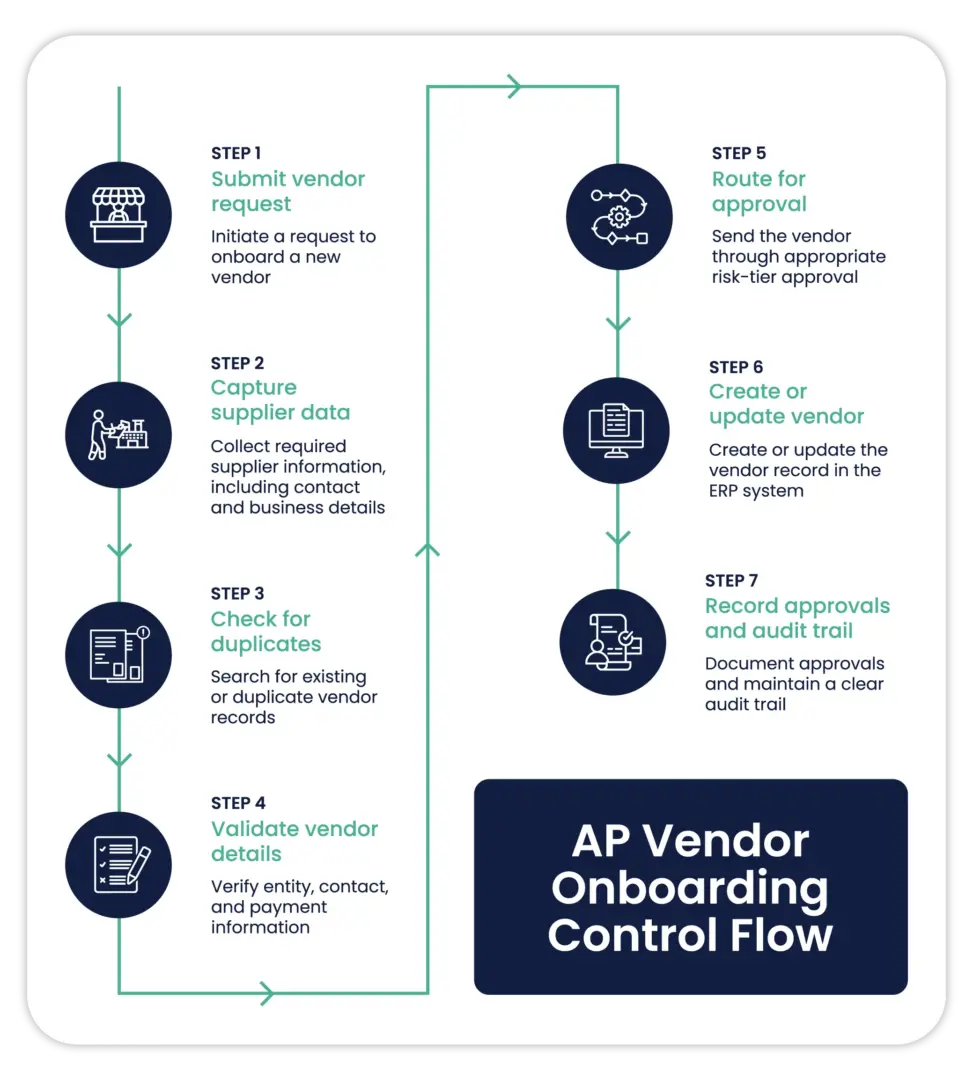
The goal is not a perfect, touchless process. The goal is a repeatable workflow that creates clean vendor records and reduces exceptions downstream.
Start with one submission path. That could be a controlled form, a portal, or a standard template, but the point is the same: the supplier details should arrive in a consistent structure, not scattered through email threads.
Make the requester’s accountability explicit. Require the name of the internal owner for the relationship, and capture why the supplier is being added. That internal owner becomes the person AP can go back to when something is missing, disputed or needs urgent confirmation.
Before a new record is created, run a duplicate check. Most duplicates are created because of trading names, abbreviations, punctuation, and rushed requests where nobody checks what already exists.
The information AP should capture every time
Most teams don’t need a long list. They need a minimum dataset that supports vendor data quality and prevents avoidable exceptions later.
At a practical level, that minimum dataset usually includes the legal entity name and address, remittance contact details, payment method details required by policy, and any internal references your ERP needs to route invoices correctly. If those fields are missing or inconsistent, the “urgent” setup becomes a future exception.
If you want a simple test, ask: Could an AP team member, who has never seen this supplier, confidently validate an invoice and pay it correctly from the data we captured? If the answer is no, the dataset is too loose.
What to validate before approvals
Validation is where AP protects the organisation from bad data becoming permanent. Strong validation improves vendor data quality before supplier records are created or updated in the ERP.
At minimum, validate that the supplier does not already exist, that the entity and contact details are consistent, and that payment details meet your control approach. This is also where you separate data collected from data trusted.
In practice, the highest risk habit is copying bank details from email into the ERP. It feels efficient in the moment. It also creates the conditions for both honest errors and social engineering to succeed.
Tiered approvals without red tape
Approvals should protect the organisation without turning onboarding into bureaucracy. A tier model is one of the simplest ways to balance speed and control.
Low-risk suppliers follow a light path, with clear accountability and basic validation. Higher risk suppliers trigger additional review. Typical triggers include high expected spend, unusual terms, sensitive access, and urgency combined with incomplete details. The point is not to slow everything down. The point is to apply the right level of scrutiny where exposure is higher.
Why are bank details the control you shouldn’t compromise on
Bank detail changes are one of the highest risk moments in the supplier lifecycle, and this is where vendor onboarding controls matter most. Treat changes as higher risk than initial setup.
A defensible approach is to require independent verification using your approved method, to log approvals in a way that stands up to audit, and to limit who can edit sensitive fields in the ERP. This isn’t about distrusting suppliers. It’s about reducing exposure to social engineering and preventing rushed errors from becoming losses.
ABN and entity consistency for Australian teams
For Australian organisations, vendor onboarding often includes capturing consistent entity details and, where relevant to your policy or reporting, identifiers such as ABN.
The key is consistency and clarity. Record what your AP and ERP process needs, and keep Australian-specific requirements in a clearly marked section of your procedure so the core workflow remains reusable across business units.
How to measure vendor onboarding quality
You’ll usually see improvement quickly if you track two operational measures: cycle time from request to active, and first pass completion rate (how often onboarding completes without rework).
For quality and control posture, track duplicate vendor creation rate, the number of invoice exceptions caused by vendor data, and payment reissues linked to incorrect supplier master data. If AP is routinely chasing missing fields, your data capture requirements are too loose.
Frequently Asked Questions
What’s the difference between vendor onboarding and supplier onboarding?
Vendor onboarding is AP and finance setup for payments and vendor master governance. Supplier onboarding, in procurement, is trading readiness and enablement.
How do we prevent duplicate vendors?
Make duplicate checks mandatory before approval, standardise naming conventions, and require an internal owner so requests don’t come through as anonymous.
What control matters most?
Bank detail governance, particularly for change requests, because the financial exposure is immediate.
How should AP handle urgent same-day onboarding requests?
Use a defined urgent path rather than skipping controls. Require the minimum dataset, complete duplicate checks, and perform bank detail verification using the approved method. If the required information cannot be validated, pause activation and document why.
Who should be allowed to request and approve vendor master changes?
Requests should come from an accountable internal owner, not directly from the supplier. Approvals should be tiered by risk, and sensitive updates should require independent verification plus logged approval, with editing rights restricted in the ERP.