
Many organisations use supplier onboarding to mean finance setup: collecting payment details, creating a record in the ERP, and confirming invoice requirements. Those steps matter, but supplier onboarding for procurement is about more than finance setup and does not solve procurement’s recurring pain on its own.
Procurement feels the pain when a supplier is technically approved yet operationally unready. Ordering rules are unclear, PO acknowledgements are inconsistent, delivery expectations are vague, and exceptions become normal. Supplier onboarding in procurement is about trading readiness. The core question is not whether we can pay them. It’s can they supply reliably through our process?
Why approved suppliers still fail in execution
Most post-go-live problems come from ambiguity. Suppliers don’t confirm orders, stakeholders chase progress updates, lead times change informally, and disputes increase. Users bypass channels because catalogues are not enabled or ordering rules are unclear, which creates pricing noise and mismatch risk.
Onboarding prevents these issues by making ways of working explicit before transactions begin.
Supplier onboarding for procurement beyond finance setup
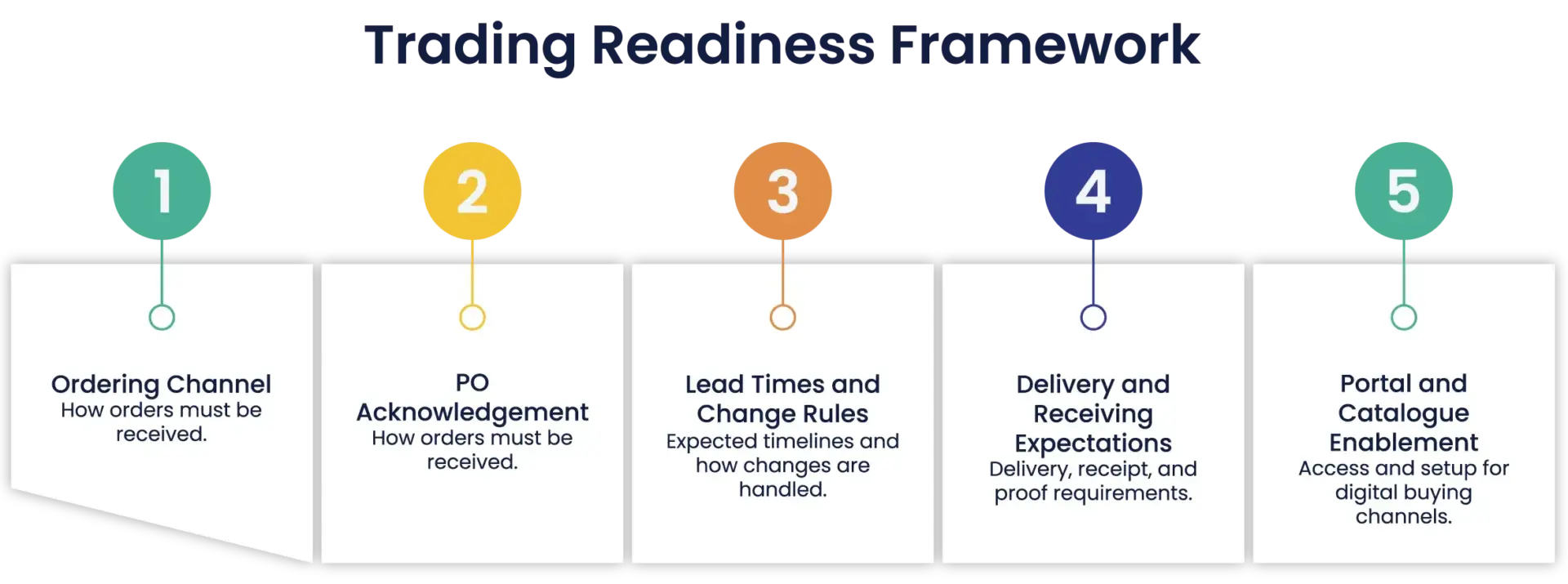
A supplier onboarding process in procurement enables suppliers to participate in your buying workflows, so ordering, delivery, communications and category requirements are understood before the first PO is raised.
It includes operational suitability for the category, trading rules, enablement in your ordering channels, and early performance stabilisation. Finance onboarding, by contrast, focuses on payment readiness and vendor master controls, while procurement supplier onboarding focuses on trading readiness and execution.
Trading rules that prevent early exceptions
Start with ordering channel clarity. If you require portal-based ordering, make it explicit. If POs are emailed, confirm the correct address, format and response expectations.
Then standardise PO acknowledgement. Define who acknowledges, what must be confirmed, and how quickly. In practice, acknowledgement discipline is one of the quickest ways to reduce the question of where my order is. noise.
Next, define lead times and change management. Clarify how substitutions, backorders, and date or quantity changes are proposed, and who approves them. Without clear rules, changes happen informally and disputes follow.
Finally, align delivery and receiving expectations. For goods, that might include delivery windows, booking requirements and paperwork. For services, it is often scheduling rules, completion evidence and escalation pathways.
Enablement for portals, catalogues and digital channels
If you expect suppliers to transact through a portal, catalogue, procurement network or structured workflow, onboarding must include enablement. That means access setup, minimum profile requirements, and a shared understanding of how to transact.
Catalogue enablement is often the practical lever. When items or services are structured and visible, users are less likely to free-text orders that drive mismatches and disputes. If you have integrations, run a simple first transaction test before real orders begin. It is easier to fix a workflow issue on a test PO than during a live delivery escalation.
How do you tier onboarding depth without slowing low-value suppliers
Not every supplier needs the same depth. Tier onboarding by operational impact. High-impact suppliers get deeper enablement and a clearer stabilisation rhythm. Low-impact suppliers follow a lighter path, with the core trading rules still made explicit.
The point of tiering is to keep the supplier onboarding process fast for low-risk suppliers while still protecting procurement execution for high-impact categories.
Australian operational requirements in practice
In Australia, this tends to show up in category controls and operational requirements, particularly in environments like government, infrastructure, healthcare and enterprise services. The practical takeaway is to embed local realities in the trading rules and category controls you confirm, not in generic onboarding steps.
Signals that supplier onboarding is working
Procurement success should show up in trading outcomes, not in how many forms were completed.
Useful measures include time to first successful PO, PO acknowledgement timeliness, channel or catalogue compliance, and early delivery or service performance. If your first PO completes cleanly and the second one does too, you have probably set the supplier up properly.
For a view of how PO and invoice processing connect across the lifecycle, see the related article on ERP invoice processing.
Frequently Asked Questions
Is supplier onboarding the same as vendor onboarding?
Not in procurement. Supplier onboarding is trading readiness and enablement. Vendor onboarding is finance and AP setup for payments and vendor master governance.
What trading rules matter most upfront?
Ordering channel, PO acknowledgement expectations, lead times, change approvals, and delivery or receiving requirements.
Do all suppliers need the same onboarding depth?
No. Tier by impact, so high-impact suppliers get deeper enablement and low-impact suppliers have a lighter path.
What should procurement do when a supplier refuses your portal or catalogue process?
Confirm whether the requirement is mandatory for the category or preferred. If mandatory, set expectations upfront and provide enablement support such as quick start guidance and test transactions.
If negotiable, allow an interim method with clear rules and a deadline to transition.
When should procurement involve internal stakeholders during onboarding?
When onboarding decisions affect day-to-day execution: ordering workflows, receiving constraints, site access and service scheduling. A short pre-go-live alignment prevents workarounds later.