
Not every fraud attempt arrives with drama. Often, fake invoices and forged documents look like perfectly ordinary supplier invoices, routine forms, or expense receipts that seem familiar enough to approve without much thought.
That is the risk in a world where synthetic documents are cheap and fast to produce. A fraudster does not need to break your systems if they can create paperwork that passes the eye test and then ride your normal workflow into a payment run.
The practical shift is moving from document trust to process trust. Instead of asking does this look real? The safer question is, has this passed the controls we rely on every time?
Synthetic documents in finance
Synthetic document fraud includes many forms of forged documents in finance, from fake supplier paperwork to altered receipts and manipulated invoices designed to trigger a payment or approval outcome. Sometimes it is external. Sometimes it is internal and opportunistic.
Externally, the fraudster might copy a real supplier’s layout, choose an amount that feels low risk, and change the bank details. Internally, it can be expense receipts edited after the fact, invoices raised by entities connected to an employee, or older invoices resubmitted with small changes.
In practice, the common feature is that visual familiarity is being used as the control. That is exactly where fraud is accelerating.
Where do fake invoices and forged forms usually enter the workflow
Most organisations have four pressure points.
Supplier Onboarding
Where new suppliers submit details and supporting documents. This is also where supplier onboarding fraud can enter the workflow if teams rely on email attachments or paper forms that only need to look complete.
Supplier Maintenance
Bank account changes. This is the highest leverage point. If a fraudster can redirect where a legitimate supplier is paid, they do not need to create a new supplier at all.
Invoice Processing
When invoices arrive as emailed PDFs or scans and require manual checking, teams are pushed back into visual judgment rather than structured validation.
Employee Expenses
The values can be smaller, but the volume and repetition can make it easier for altered receipts to slip through unless controls are applied consistently.
How do we harden supplier onboarding and bank detail changes
The biggest improvement comes from removing ad hoc handling.
When onboarding is done through a structured workflow, you can enforce mandatory fields, consistent approvals, and a clear history of who submitted what and who approved it. That matters because a fake form is less useful when it has to survive a defined set of checks rather than one person’s judgment.
In an Australian context, validating supplier identity often starts with verifying the ABN against the Australian Business Register and confirming the legal name matches what is being provided. The aim is not to turn AP into compliance auditors. It is to stop mismatched identities entering the supplier master file and becoming a downstream risk.
Bank details should be treated as high risk every time, because bank detail change fraud remains one of the most effective ways to redirect legitimate supplier payments. Good practice is to verify changes using a known contact channel already on file, rather than the phone number or email signature included in the request. Many organisations also introduce stronger approvals for bank changes, and in higher-risk environments, a short delay before new details can be used helps reduce successful redirection.
A forged bank letter can look convincing. It is much harder for a fraudster to succeed if they cannot pass independent confirmation through a separate channel.
In some organisations, that independent confirmation is strengthened by using a dedicated bank detail verification service rather than relying only on manual call backs. Where Eftsure is used, supplier bank details can be verified through Eftsure as part of onboarding and change requests. If RapidAP is the workflow layer, the Eftsure verification step can sit inside the governed process so the result is recorded and any mismatch is routed as an exception, rather than being handled informally through email.
Why AP teams must shift from document trust to process trust
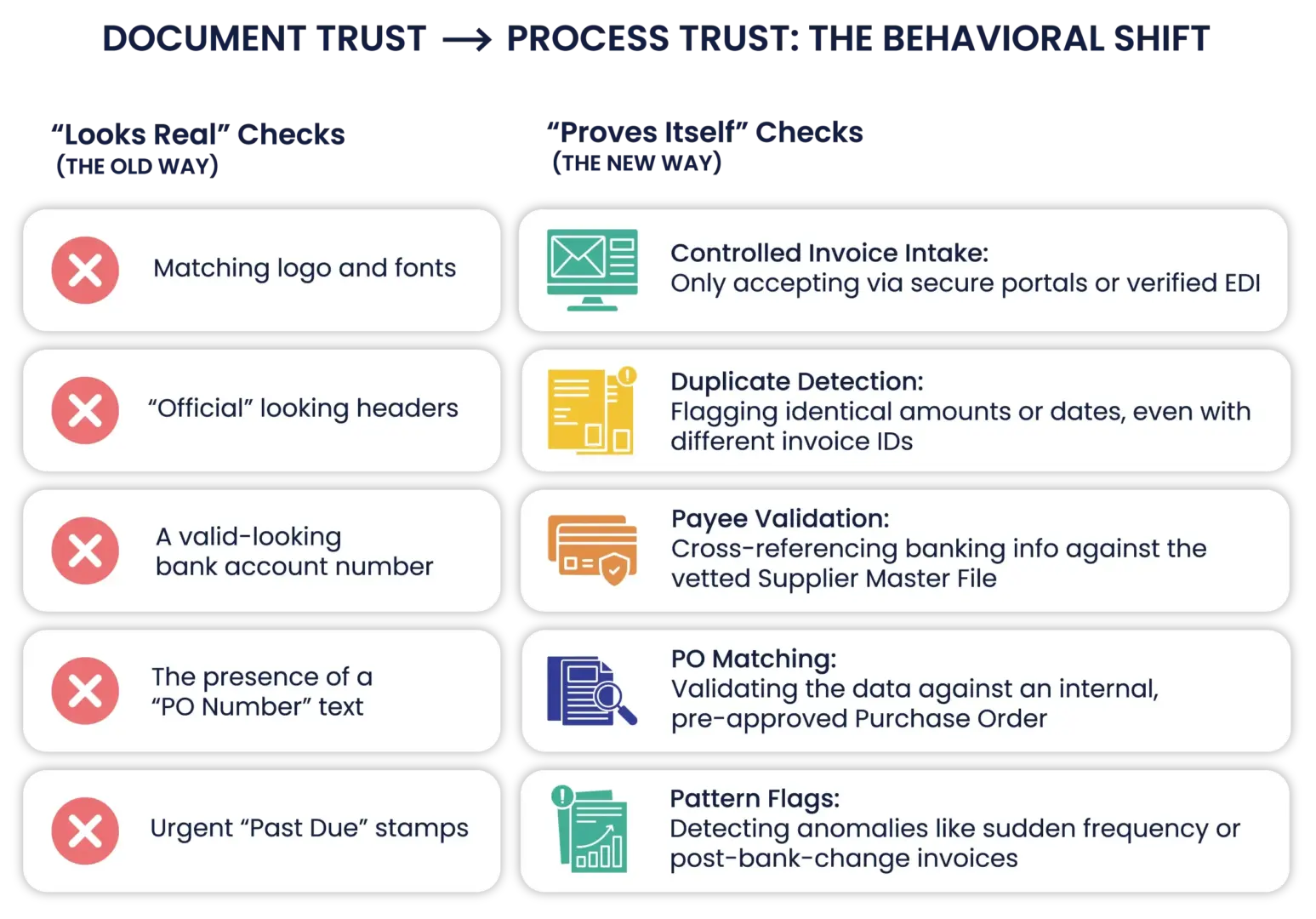
This shift sits at the heart of accounts payable fraud prevention, especially when fake invoices and forged documents are designed to pass a basic eye test.
Workflow controls that stop fake invoices and forged documents
The practical goal is to reduce reliance on appearance by increasing reliance on behaviour.
Centralising invoice ingestion helps because it creates one controlled path into your workflow. When invoices enter through defined channels, you can apply the same validation steps every time, rather than relying on individual inbox habits.
From there, rules-based checks can test whether the invoice behaves like a legitimate transaction. Matching to purchase orders where applicable is one of the strongest behavioural checks because it ties the invoice back to an approved commitment. Duplicate detection helps because recycled invoice numbers and near duplicates remain common tactics. Payee validation against the supplier master matters because many fake invoices fail at the point where the bank details do not align with known records.
For bank detail changes specifically, some teams add an independent verification step such as Eftsure, captured in the RapidAP workflow, so payee details are confirmed through a controlled process before the invoice progresses.
Other behavioural checks focus on patterns. If a supplier that is normally paid monthly suddenly submits three invoices in a week, or if a large invoice arrives immediately after a bank change request, that combination should slow down and move into review. The point is not to assume fraud. It is to treat unusual behaviour as needing verification before approval.
What about expense receipts and internal document manipulation
Expense fraud is often overlooked because individual values are smaller, but forged expense receipts and altered claims can add up quickly when controls are inconsistent.
Many organisations strengthen this area by setting clearer evidence requirements above certain thresholds and running periodic spot checks. The focus is on outliers, repeated claims, and unusual patterns, not on policing every coffee receipt. Capturing receipts close to the point of spend also reduces the window for editing and recycling.
The mindset shift AP teams need to make
For years, finance teams have relied on practical judgement. If it looks familiar and the numbers roughly add up, it is probably fine. That approach is becoming less defensible as document generation gets easier.
A safer operating model is this: a document is only trusted once it has passed the structured checks in your workflow. If it tries to pull the process into side channels, or if it cannot meet the validation steps you apply consistently, it is high risk by default.
Key takeaways for stopping fake invoices and forged documents
- Stop relying on looks real and require consistent workflow checks.
- Treat supplier onboarding and bank detail changes as the biggest leverage points.
- Use centralised ingestion, PO matching where applicable, and duplicate detection as core behavioural controls.
- Validate payee details against the supplier master and escalate mismatches automatically.
- Keep expense controls focused on thresholds and outliers rather than policing every claim.
Where can workflow tools help, without pretending they solve fraud alone
Workflow tools help by enforcing consistency. They make sure invoices enter through controlled channels, validations happen every time, approvals follow thresholds, and exceptions are visible rather than hidden in email threads.
In RapidP2P, that consistency is implemented through rules-driven workflows. Invoices captured in RapidAP can be checked for duplicates and validated against supplier records, with exceptions routed for review. Supplier onboarding workflows can enforce ABR validation so identity checks happen before supplier details enter the master file. For bank detail changes, Eftsure can be integrated into the RapidAP workflow so verification is independent, recorded, and harder to bypass when pressure is high.
Frequently Asked Questions
What is the highest risk point for fake invoice fraud in AP?
Supplier bank detail changes are usually the highest leverage point. If a fraudster can redirect where an existing supplier is paid, they do not need to create a new supplier or pass onboarding checks. Treat changes to where money goes as high risk every time.
How do we validate a supplier during onboarding in an Australian context?
How do we validate a supplier during onboarding in an Australian context?
A practical starting point is verifying the ABN against the Australian Business Register and checking the legal name matches what is being submitted. This helps stop mismatched identities entering the supplier master file and becoming a downstream payment risk.
How can we verify supplier bank detail changes without relying on the email thread?
Move the request into a controlled workflow and verify using a trusted channel already on file. Where an independent verification service is used, such as Eftsure integrated with RapidAP, keep the verification outcome recorded in the workflow so mismatches are routed as exceptions and evidence is retained.
What controls catch fake invoices that look visually convincing?
Behavioural checks are more reliable than visual review. Duplicate detection, payee validation against the supplier master file, and matching to purchase orders where applicable help surface anomalies early and route them for review.
What evidence should we keep to support audit and dispute resolution?
Keep the request details, who approved it, what verification steps were completed, and the outcome of any exceptions. For bank detail changes, retain clear evidence of how details were verified and who signed off, stored in the system of record rather than in email.